 Xeno Leads
Missed a Call? What Happens in the Next 60 Seconds Decides the Job
The short answer
When you miss a call, plenty of callers just tap the next shop on their screen. A missed-call text-back sends them a short, personal text within seconds, so they have a reason to wait for you. Keep it human, ask one question, then test it by calling your own line from another phone.
You're under a sink, on a ladder or halfway through a windshield. The phone rings. You can't get it. By the time you call back, they've booked someone else.
Why don't they just leave a voicemail?
Because they don't need you, they need someone who can come, and the next shop is one tap away. Think about what the caller is doing. They searched, saw three or four shops, and tapped the first number. Nobody answered. Their screen is still showing the other three shops.
Plenty of people don't leave a voicemail. They aren't being rude. They have a cracked windshield or a leaking pipe, and they want to know who can come and when. A voicemail greeting doesn't tell them either.
That's why a callback an hour later often finds a customer who already booked, or who doesn't pick up an unknown number. Speed matters with any new lead. In a 2011 Harvard Business Review article, researchers James Oldroyd, Kristina McElheran and David Elkington wrote that most companies are not responding to online leads nearly fast enough (Harvard Business Review). That was about web leads, not phone calls, but the lesson carries: the first shop to respond has a head start.
You can't answer every call. You can answer every caller.
What is a missed-call text-back?
It's a text that goes out automatically, within seconds, to anyone whose call you didn't pick up. The caller is still looking at their phone when it arrives. Instead of "this shop didn't answer," the message they get is "this shop saw my call and will get back to me."
It does three things:
- It stops the next call. A reply in seconds gives them a reason to wait for you.
- It starts a conversation they can answer from anywhere. Some people would rather text than talk, especially at work.
- It tells you what they need before you call back. "Rear window shattered, can you do today?" is a much better callback than "Hi, you called?"
What should the text say?
Keep it short, human and from a person, not a company. This is the first script in our free Text-Back Scripts:
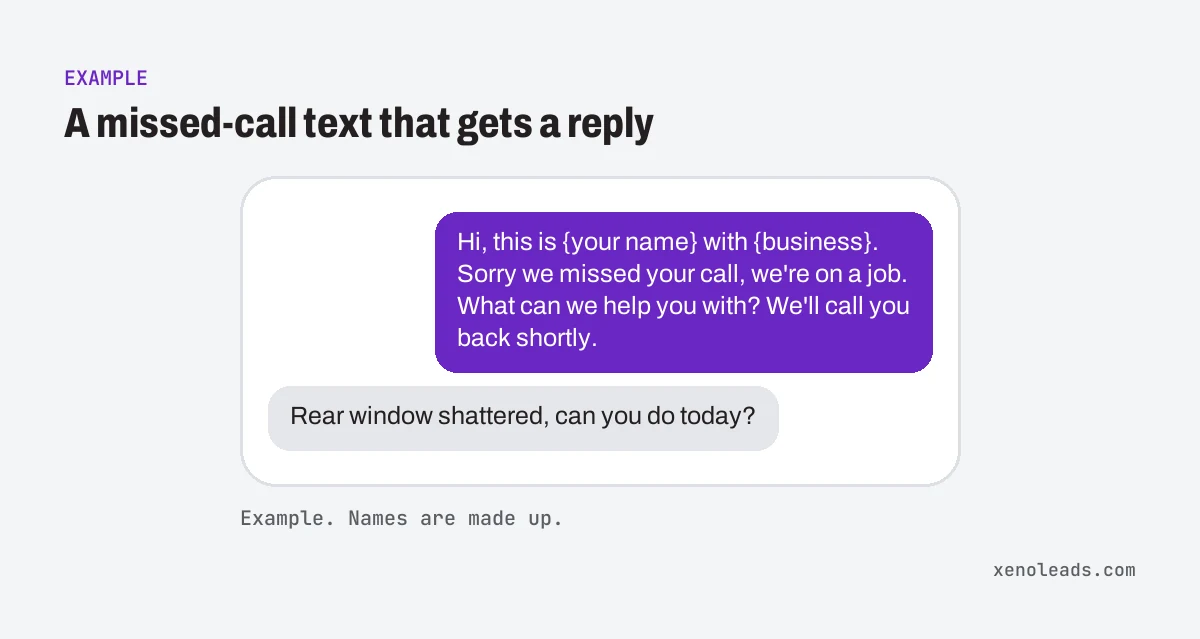
Hi, this is {your name} with {business}. Sorry we missed your call, we're on a job right now. What can we help you with? We'll call you back shortly.
Why it works:
- A name. People reply to a person.
- A reason. "We're on a job" tells them you're busy because you're good, not because you're ignoring them.
- One question. "What can we help you with?" is easy to answer in a few words.
- A next step. "We'll call you back shortly" tells them what happens next. Then do it.
What to leave out: links on the first text, long menus ("Reply 1 for..."), and anything that sounds like a robot. The point is to sound like the shop picked up.
How do I check mine today?
Test it the way a customer would meet it, from a phone that isn't yours.
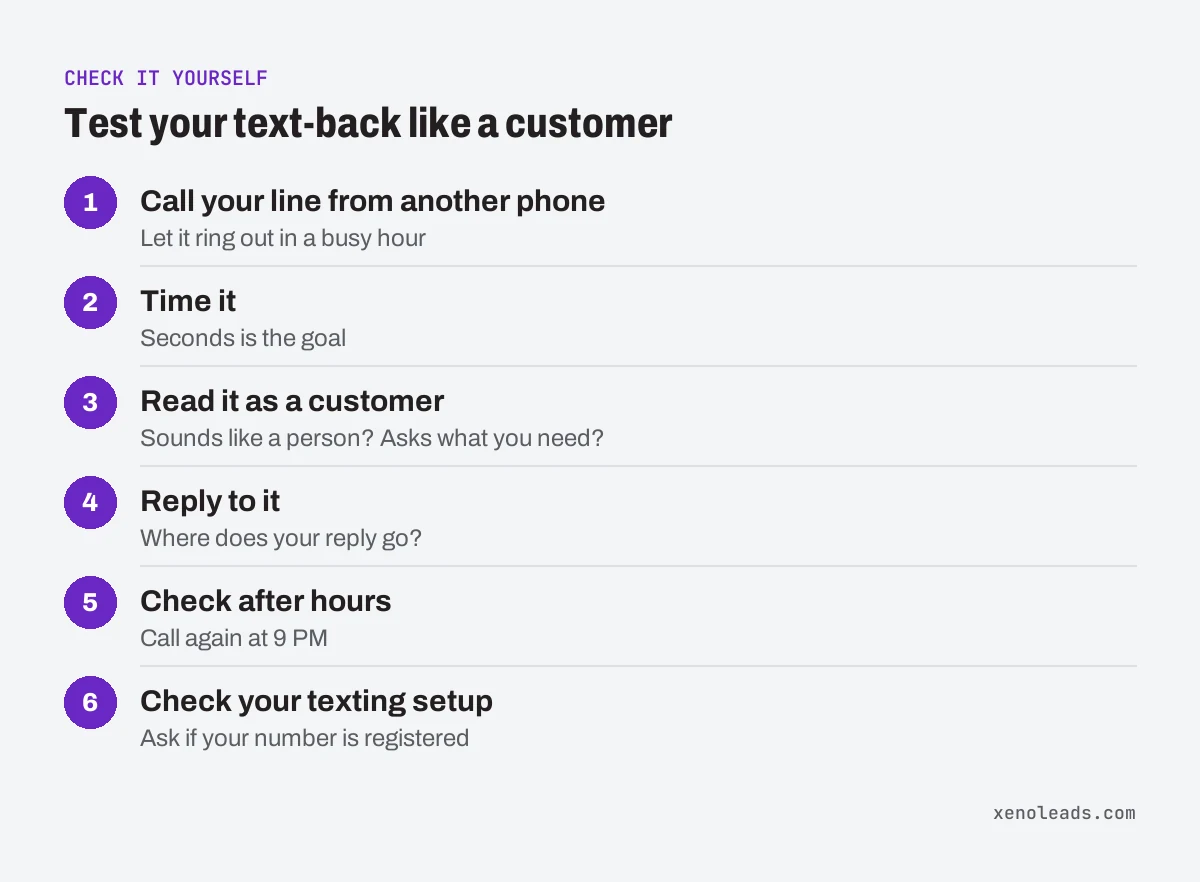
- Call your own business line from another phone during a busy hour. Let it ring out.
- Time it. Do you get a text? How long did it take? Seconds is the goal. Minutes is too slow.
- Read it as a customer. Does it sound like a person? Does it ask what you need?
- Reply to it. Where does your reply go? To your phone, a shared inbox, a CRM nobody checks? If nobody sees the reply, the text did half its job.
- Check after hours. Call again at 9 PM. The text should be different: when you open, and how to book. (That's script #2.)
- Check your texting setup. In the US, business texts sent from software over a regular 10-digit number fall under a carrier standard called A2P 10DLC. Twilio, a large texting provider, says anyone sending that way must register, that registered traffic sees lower message filtering, and that unregistered traffic gets extra carrier fees (Twilio Docs). Ask your phone or CRM provider whether your number is registered.
Two habits: text only the people who contacted you, and when they say stop, stop. The exact consent rules for business texting are a legal question, so check with your texting provider or an attorney if you're unsure.
What we do about it
On the accounts we run, the ads and the follow-up get set up together. Missed calls get a text back in seconds, form leads get a text right away, and every reply lands where the owner actually looks. Then we test it the same way as above, from a phone that isn't on the account.
Get the scripts
The missed-call text is one of eight in our free Text-Back Scripts, along with after-hours, holiday hours, new form leads, three quote follow-ups and a review ask. Copy, paste, and swap in your name.
Sources
- The Short Life of Online Sales Leads (hbr.org)
- Programmable Messaging and A2P 10DLC (twilio.com)